
The world-popular Grand Canyon State is famous for its impressive landscapes, burning summers, and being a perfect place to “trap” sun energy. Being cuddled by the vast expanse of the southwestern sky, Arizona serves as a limitless beacon of untapped solar potential. The state’s benefits of using solar power are theoretical and brilliantly practical.
Arizona has an amazing abundance of sunlight, with more than 300 days of sunshine yearly. This constant sunshine, combined with vast and flat terrains and minimal cloud cover, makes Arizona a prime location for solar power generation and is already giving you a hint to the main question – is solar worth it in Arizona?
After everything written above, it becomes evident that the synergy between the state’s climate and solar energy potential results in limitless opportunities for Arizonans for affordable electricity.
In this article, we will explore countless benefits of using solar power in Arizona, delving into societal Arizona energy pros – is solar worth it in Arizona? Besides social and environmental advantages, we will research economic issues, such as the cost of solar panels in Arizona, the cost of electricity in Arizona, the average monthly payment for solar panels, the average electric bill in Phoenix, how much solar energy costs, solar cost per kWh, etc.
We will also analyze Arizona solar installers and the best solar companies in Arizona. And, of course, we will not forget to examine and highlight the back sides of converting solar in Arizona and some specific things for Arizona consumers to be aware of when going through the solar process.

What Is the Average Cost of Solar Panels in Arizona?
Have you already noticed a serious boost in electricity rates? The average residential electricity price in Arizona reached about 15.6 cents per kWh in early 2026. Together with the hot climate, it stimulates people to go solar, and requests all over the internet of type “Is solar worth it in Arizona?” are getting more and more frequent. At the same time, the Solar Energy Industries Association (SEIA) reports that the equipment for solar energy has become more affordable by about 52% in the Grand Canyon State over the last decade—a perfect time for Arizonans to make the switch to solar energy.
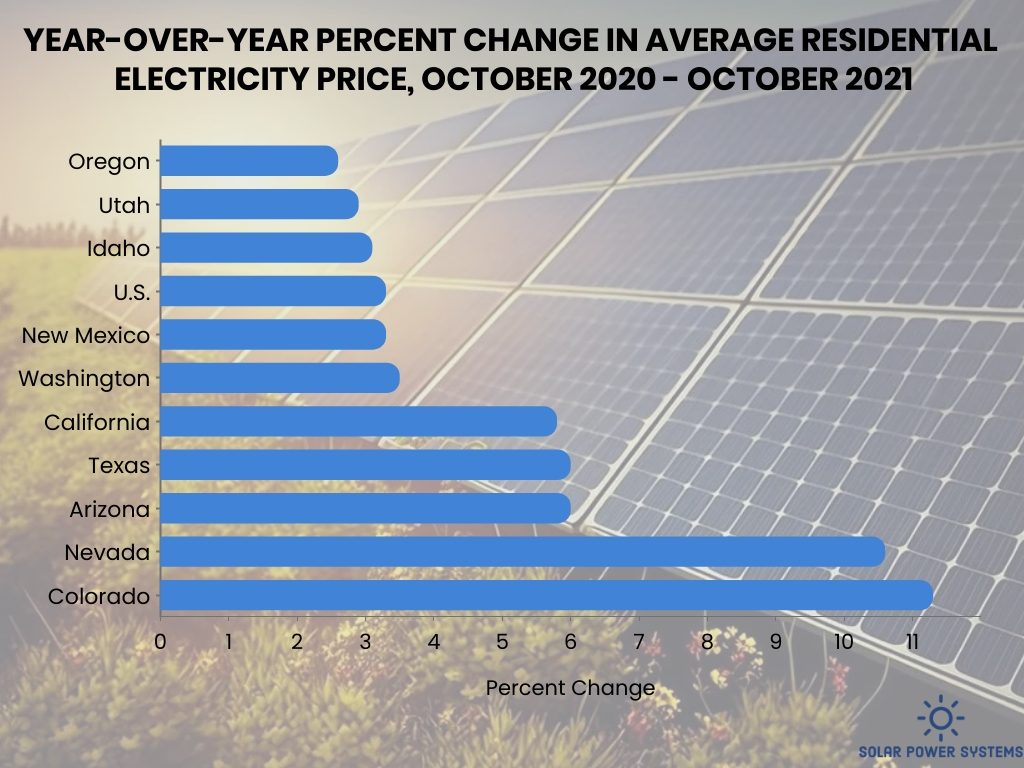
Year-Over-Year Percent Change in Average Residential Electricity Price, October 2020 – October 2021
According to EnergySage, Arizonans pay an average of about $2.26 per watt for solar panel installation in 2026, or around $11,300 for a 5 kilowatt (kW) system and about $30,400 for the average-sized 13.4 kW system. This price includes installation but doesn’t include possible state and local incentives. Keep in mind that the 30% federal solar tax credit for homeowners ended for systems installed after December 31, 2025. However, Arizona still offers a 25% state tax credit up to a maximum amount of $1,000. The state also provides sales and property tax exemptions for solar panels.
In most Arizona locations, solar panel systems produce over 1,800 kWh annually, according to the World Bank Global Solar Atlas. For example, if you live in Phoenix and will install a 5 kW system you can expect panels to generate over 9,000 kWh of energy annually.
According to the U.S. Energy Information Administration, the average residential electricity price in Arizona is about 15.6 cents per kWh. If your panels create 9,000 kWh of solar energy and you use most of it at home, you can save up to about $1,400 per year on electricity expenses. A typical 5 kW solar system costs around $11,300 before the $1,000 state tax credit, so it could pay for itself in roughly 8-10 years, depending on how much of your solar power you use yourself rather than export at lower net billing rates. For the average-sized Arizona system, EnergySage estimates a payback period of about 13 years.
Over the next few decades, Arizonans’ and Americans’ expenses for installing solar panels should continue to decline. By 2030, the Department of Energy intends to cut the cost of solar energy in half, making the investment easier and reducing the time it takes to recover installation costs.
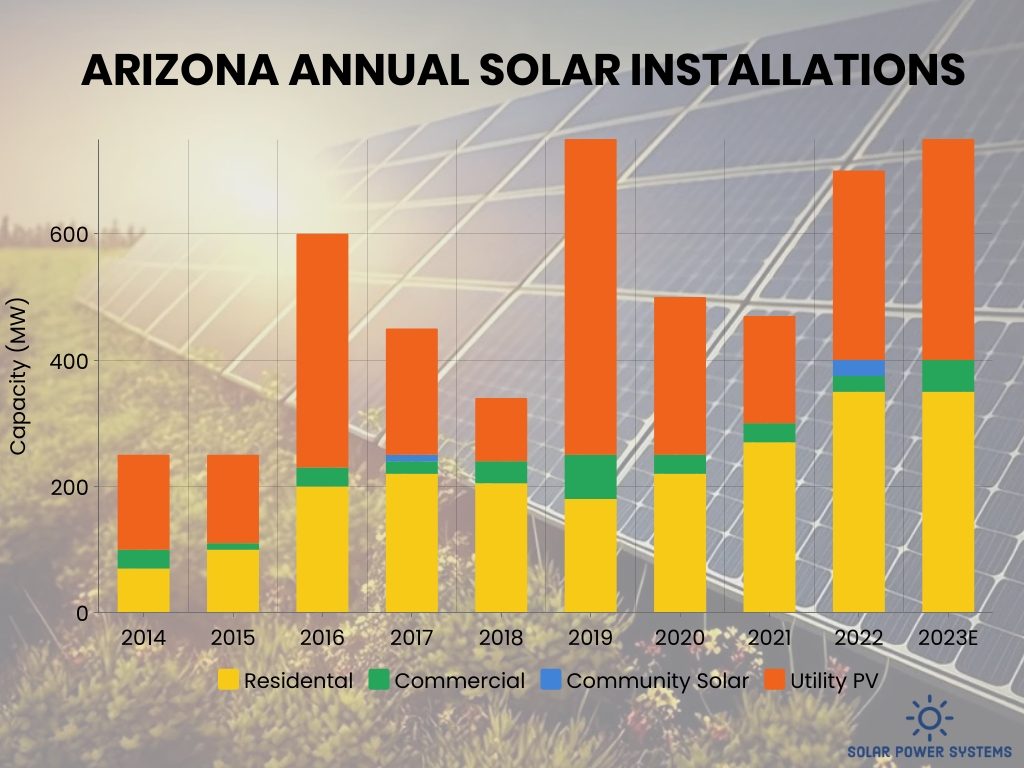
What Goes Into the Average Price of Solar Panels in Arizona?
Solar System Size
Usually, before installation, the company you choose performs a site assessment to determine the size of your solar system to cover your energy needs.
The cost of your solar system depends on number of panels you need to power your house. Your solar panel will produce more energy here than in other states because Arizona gets a lot of sunshine. Shade, wiring, and inverter efficiency costs must be considered since no system is 100% efficient.
Panel Type and Brand
The solar panel type you select will also have an impact on project expenses. Although they cost more, monocrystalline solar panels are more effective at converting sunlight into electricity than polycrystalline ones. Premium solar panels with 25-year guarantees from prominent manufacturers will cost more.
Installation Company and Complexity
Your total solar expenses can be significantly influenced by local labor rates and the solar installer you choose. Labor and installation fees account for a fraction of the overall cost of your solar system; solar panels, inverters, and other equipment only make up about 47% of the total. For instance, if the intricate shape of your roof makes installing solar panels more challenging, you should budget more. Due to higher overhead, large solar companies typically charge more for installations than smaller, local businesses.
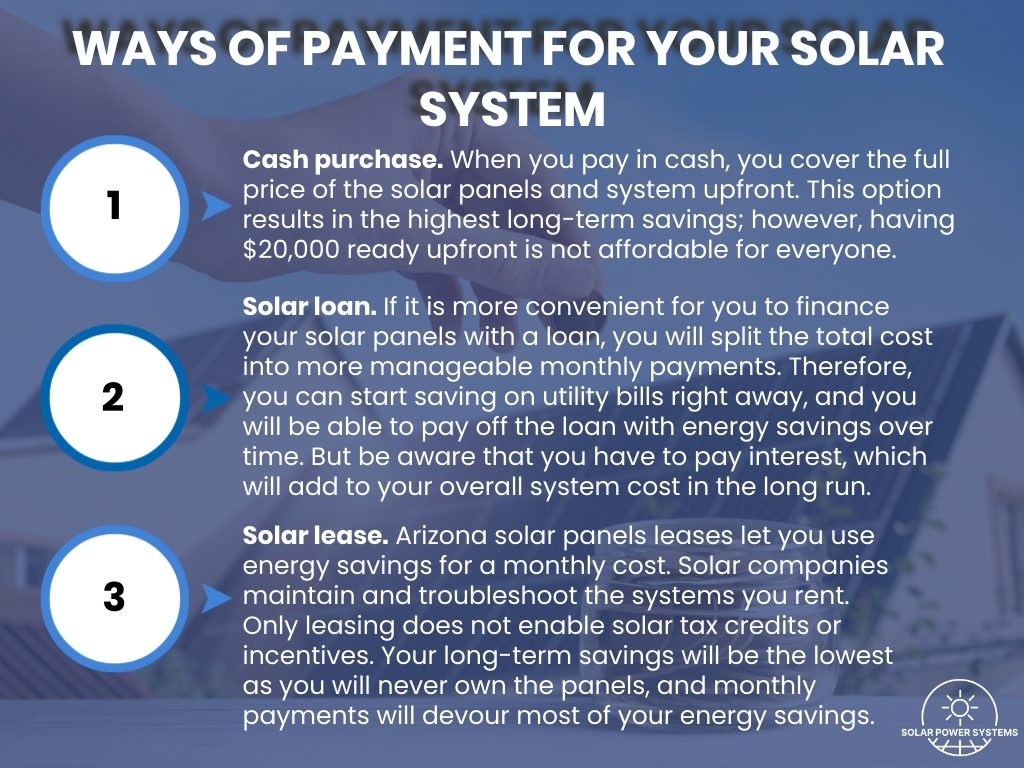
Financing Options
Maintenance Costs
Solar panels are durable and low-maintenance. If dust and other particles that impede sunlight are removed, high-quality modules can generate electricity for decades.
Annual solar energy system maintenance costs are usually less than 1% of its initial cost. Some solar providers offer free cleaning for a limited time after installing your panels.
What Financial Incentives Exist in Arizona?
To motivate citizens to switch to renewable energy sources, the majority of states provide solar incentive programs. Let’s delve into the following incentives more deeply:
Federal Solar Tax Credit (ITC)
Until the end of 2025, homeowners could claim the 30% federal solar tax credit (Residential Clean Energy Credit), which the Inflation Reduction Act raised from 26% to 30% in 2022. However, the One Big Beautiful Bill Act of July 2025 ended this credit for systems installed after December 31, 2025, so it’s no longer available for solar panels you buy with cash or a loan.
If you lease your system or sign a power purchase agreement (PPA), the solar company may still claim a commercial tax credit and pass part of the savings on to you through lower monthly payments.
Residential Solar Energy Tax Credit
Solar energy systems in Arizona get a tax credit equivalent to 25% of their value or $1,000, whichever is less. Your system must either be installed on land you own or lease, and it must have a minimum capacity of 5 kW. When you file your taxes within the year your system is installed, credit is applied.
Solar Equipment Sales Tax Exemption
Arizona’s 5.6% sales tax does not apply to solar panels, so purchasing equipment now will save you money right now. It includes lithium-ion batteries and is accessible to both commercial and residential users. If individual tax codes do not clearly state otherwise, the exemption does not apply to additional sales taxes levied by cities.
Energy Equipment Property Tax Exemption
After solar panels are installed, any rise in the value of a home in Arizona is not subject to taxes. You will, therefore, continue to pay property taxes for a $400,000 home even if your solar power system raises the value of your $400,000 Arizona home to $430,000
Net Billing
Since 2009, Arizona net metering has been implemented. A decision to switch from net metering to net billing was taken in 2016 by the Arizona Corporation Commission (ACC). Accordingly, energy exported to the grid by new customer-generators is rewarded at an avoided cost rate.
Through the program, you can receive credits for any extra energy your solar panels create. You can return excess energy produced by your solar panels to the utility grid in order to receive credits toward future electricity bills, should you need more energy than your home requires. You can carry over the balance to the following month if there is a billing period during which your solar credit is greater than your electricity expenditure.
Your solar capacity cannot be greater than 125% of the total energy used by your equipment or your connected load in order to be eligible for this rebate. Your utility provider will determine the exact amount per kilowatt-hour that you will be compensated for any excess energy that your solar panels produce.
Export rates depend on your utility and are locked for 10 years from your installation date, but they drop by up to 10% per year for new customers. Because export credits are much lower than retail electricity rates, using more of your solar power at home or storing it in a battery saves more than exporting it. Approximate 2026 export rates for the largest utilities are:
- Arizona Public Service (APS): about 7.0 cents per kWh
- Tucson Electric Power (TEP): about 8.4 cents per kWh
- Salt River Project (SRP): about 3-4 cents per kWh, plus monthly demand charges on solar plans
What Should Arizonans Be Aware of When Considering Going Solar?
While determining whether solar panels are a good investment for your house is a significant first step toward switching to clean energy, there are a few more things to think about along the way. We’ll go over a few things to consider if you want to convert to solar power in Arizona.
- Upfront fees: The initial costs of a solar panel system are always important to take into account, particularly in a place like Arizona, where high energy use necessitates enormous, pricey solar arrays. Reduce your upfront costs by installing only the equipment you need, selecting less expensive manufacturers of solar panels, and obtaining a zero-down payment solar loan. Since the federal tax credit for homeowners ended after 2025, solar leases without upfront costs can now also be competitive, so compare lease, loan, and cash offers carefully.
- Payback period: Every household should calculate or have a local solar provider estimate the time it will take their panels to pay for themselves. The solar panel payback period indicates how worthwhile solar will be for your home and how high your ROI will be. Arizona has an average payback of about 13 years, according to EnergySage. Your ROI will be smaller, and savings will take longer if yours is longer.
- Policy and incentive changes: Although the use of solar energy is already rather widespread in Arizona, it is still growing in popularity. The incentives, subsidies, and solar laws, including net billing, are susceptible to change. For example, the federal tax credit for homeowners ended after 2025, and Arizona export rates drop by up to 10% per year for new customers. Waiting for higher incentives is not a good idea, but you should check for policy updates before switching to solar power.
- Climate conditions: Arizonans rarely worry about the weather while installing solar panels because most days are sunny and efficient. Many homeowners worry about their solar panels during the rainy season, but choosing a supplier with a strong physical protection warranty will rest their minds. Your panels’ efficiency can dip below 10% on rare wet and cloudy days, but the rain will naturally wash dirt and debris off, improving efficiency during sunny weather.
- Leases vs. PPAs companies’ offers: Last but not least, you should look out for companies that offer “free panels,” solar leases, or power purchase agreements. The low initial cost of leasing solar panels makes it appealing, but in the long run, it usually doesn’t save as much and doesn’t increase the value of your house. However, since the federal tax credit for homeowners ended after 2025, leases and PPAs are now the only way to benefit from a federal credit (claimed by the provider), so compare offers carefully. Before you hire a solar installer for your home solar project, find out about the company’s reputation, level of customer service, and vetting process.
What are the Top 3 Arizona Solar Companies?
Based on their reputation, cost, panel performance and selection, and customer feedback, we suggest the following companies if you’re prepared to look for a solar provider.
Sunrun
Sunrun is the largest residential solar company in the US and serves many Arizona markets. It focuses on solar leases and power purchase agreements, which can still benefit from a federal tax credit claimed by the company, and also offers solar battery storage and purchase options.
Blue Raven Solar
One of the best Arizona solar companies is Blue Raven Solar. In 2024, after the original SunPower went bankrupt, Complete Solaria acquired Blue Raven Solar along with the SunPower brand. It provides a two-year power production guarantee in addition to a 25-year warranty on monocrystalline panels from multiple manufacturers. Customers can finance their systems with Blue Raven via a solar loan or by paying in full at the time of installation. The supplier also has excellent client feedback and an A+ BBB rating.
Tesla Energy
Tesla sells high-tech solar equipment in addition to cars. Tesla Solar sells monocrystalline panels, which pair with its Powerwall 3 battery. Note that Tesla discontinued its Solar Roof tiles in August 2026, so it now offers only solar panels. Upfront cash purchases and solar financing are alternatives.
In general when choosing Arizona solar company or any other state, there are several crucial moments to remember and take into consideration:
- Solar equipment, installation, and services
- Warranty and performance guarantees
- Brand reputation and certifications
- Financing options
- Experience
- Availability
Conclusion
Arizona has plentiful sunshine, state tax incentives, and net billing for exported solar power, making solar panels a good investment for many homes. A 10 kW residential solar system in Arizona costs around $22,600 before incentives, at about $2.26 per watt. If positioned in Arizona’s best sunlight, your panels can create over 18,000 kWh per year, which can save you up to about $2,800 per year at current electricity rates if you use most of that power at home. EnergySage estimates that the average Arizona system saves about $36,800 over 25 years.
In Arizona, choosing to switch to solar energy is not a simple option. The financial benefits of leasing, PPAs, paying cash, and taking out a loan would differ depending on the specific circumstances. Furthermore, the ongoing efforts by one business to retaliate against the other may make matters more difficult. Ultimately, solar energy will, at the least, result in financial savings and a sense of accomplishment because it uses the sun’s energy to power your home’s electrical systems, saving 106 trees annually. You may make a wise choice that will benefit you for many years to come by carefully analyzing your local energy rates together with any payments you will have to make on your system. We hope that we have fully answered your main question – Is Solar worth it in Arizona?

Founder and Chief Content Officer at Resident Solar Power. Andy's been following solar policy and technology long enough to know which trends matter and which ones are just noise. He writes about photovoltaic systems, policy changes, and green tech innovations - basically, anything that helps homeowners make smarter solar decisions.